Why
did Japan Attack Pearl Harbor?
Japan's
actions from 1852 to 1945 were motivated by a desire to emerge as the dominant
power in Asia.
For Japan, World War II
grew from a conflict historians call the Second Sino-Japanese War. The Second
Sino-Japanese War began in earnest in 1937 with a battle called the Marco Polo
Bridge Incident. However, before this, there had been years of border clashes
between the Japanese and the Chinese, having started with the 1931 Japanese
invasion of Manchuria. So, to explain Japan's behavior in the years from 1941
to 1945, we have to explain why Japan invaded Manchuria in 1931, and in order
to do this, we have to go back to 1853.
Before 1852, Japan was
isolationist. Contact with the West was limited to trade with the Dutch in the
city of Nagasaki—Westerners otherwise weren't allowed in the country, and
Western influences were strongly discouraged. In 1853, Commodore Matthew C.
Perry of the United States Navy steamed into what we now call Tokyo Bay. The
Japanese told him to leave and go to Nagasaki and a short battle broke out. The
letter was eventually presented and Perry returned a year later to sign the
Convention of Kanagawa, a treaty that opened the Japanese ports of Shimoda and
Hakodate to U.S. trade.
This opening to outside
trade is the moment that modern Japanese history begins. The importance of
Perry's missions to Japan in the 1850s really can't be overstated. While Japan
had previously thought itself to be a strong country, Japan’s new openness
destroyed this self-image. While Japan's isolation had allowed the Japanese to
think that it remained a world power, the end of this isolation demonstrated
the country’s weakness.
In 1868, a reform
movement was launched to counteract this weakness, in what we now call the
Meiji Restoration. The shogun was stripped of his power, which was then
nominally placed back in the hands of the emperor but really into the hands of
his advisers. In a very brief span of time, the medieval feudal system that had
governed Japanese society for centuries was abolished, the military was
reformed, and the country was put on the path to rapid industrialization. As
part of this rapid leap into modernity Japanese citizens began to adopt
Western-style dress while the military and governments recreated themselves
along Prussian (that is to say, Germanic) lines.
The new Japanese
government began to utilize the tools of colonization to acquire the raw
materials their new industries required. The obvious target for Japanese
imperialism was just across the Sea of Japan in Korea. By the 1890s, Korea was
actually seen as a massive liability for Japan: It had not reformed as Japan
had, and unlike China, it could feasibly be conquered. Additionally, the Korean
peninsula is rich in iron and coal, which you need if you're a rapidly industrializing
country in the 19th-century. Because Japan is not particularly rich in natural
resources, it was advantageous for it to have colonies.
The problem was that
Korea was a Chinese tributary state: The Korean king paid tribute to the
Chinese emperor. While the Japanese could, and did, force the Koreans to sign
some deeply unfair treaties, the peninsula remained free of the Japanese
military. However, in 1894, China sent troops into Korea to help put down a
rebellion, not notifying the Japanese before it did so. Japan also sent in
troops to respond. Unsurprisingly, fighting broke out, leading to the First Sino-Japanese
War from 1894-1895.
The Chinese lost the war,
and they lost it badly. With the Treaty of Shimonoseki, Korea stopped paying
tribute to China and effectively became a Japanese tributary state. The
Japanese also gained the island of Taiwan as a colony, along with reparations
and trading rights in several Chinese cities. Additionally, the Japanese gained
the Liaodong Peninsula, from which several Western powers forced it to
withdraw. Not that the Chinese were allowed to hold onto the Liaodong Peninsula
either—the Russians leased it. This was the start of Japan's colonial empire,
along with a rivalry with the Russians for influence in Korea and Manchuria.
This rivalry ended up
leading to the 1904-1905 Russo-Japanese War. The Japanese emerged victorious
from this conflict and were consequently seen as a great power. The Japanese
walked away with the Liaodong Peninsula lease—formally, the Kwantung Leased
Territory—along with substantial rights in Manchuria, most notably control over
Manchuria's railroads. After the war, Japan officially made Korea a
protectorate in 1905—Russia was in no position to contest that action—and
subsequently annexed Korea in 1910.
In World War I, Japan
entered on the side of the Allied Powers and picked off Germany's colonial
empire in the Pacific Ocean as a reward for its involvement. This was probably
the high-water mark of Japan's powers prior to 1945. However, during the
interwar period, aggressively expansionist moves, though far from unheard of,
started leaving sour tastes in the mouths of many nations. It wasn't simply a
matter of geopolitics, either—most people in Europe really did not want another
war, and those countries that seemed to be provoking said wars were given the
stink eye. Because Japan hadn't suffered in the war the way that, say, France
and Belgium had, the reluctance to engage in brinkmanship simply wasn't
instilled the same way.
Also in the interwar
period, the Republic of China started getting its act together. While the
country had effectively collapsed into a patchwork of feuding warlords in the
1910s, the Kuomintang managed to get most of the south unified under its
government before embarking on what is now called the Northern Expedition from
1926 to 1928. This also brought the north of the country under the control of
the Nationalist government, which was set up in the city of Nanjing.
Nationalist China still had issues, warlords among them, but by 1928 it was a
much stronger state.
Japan viewed China's
steps toward reversing the damage of the previous century as a threat to its
control of Manchuria's railroads and of the Kwantung Leased Territory. Losing
anything to China was seen as unacceptable to the Japanese government. To that
end, in 1931, the Japanese invaded Manchuria to protect their interests in the
railroad and the Kwantung Leased Territory. Japan subsequently set up a puppet
state, Manchukuo, which nobody else recognized as a legitimate state. This
isolated Japan, and it also meant a continuing series of border clashes with
the Chinese. Eventually, in 1937, the Japanese provoked the Chinese into
full-scale war with the Marco Polo Bridge Incident.
Had the Second
Sino-Japanese War been a short one, the Japanese might have walked away with a
result similar to the First Sino-Japanese War: a hugely favorable treaty and
some land cessions. However, the Nationalist government didn't give in so
quickly and would not agree to a negotiated peace with the sort of terms the
Japanese government required to stave off a revolution.
To put it simply, the war
pushed the Japanese economy and military to the limit. Japan's supplies of
rubber, iron, and oil were pushed to the breaking point, and it had offended
nearly every one of its former allies. Increasingly, the view in the
international community was that it was a rogue state, which did not help it
procure the materials needed to keep prosecuting the war in China. An attack on
a U.S. boat on the Yangtze River alienated the U.S., as did widespread Japanese
atrocities against the Chinese population, including the rape and murder of
around 300,000 Chinese civilians in Nanking alone. Eventually, this led to
embargoes on trade with Japan.
Japan desperately needed
resources, and there were only two places to get them: Siberia and the South
Pacific. The Imperial Japanese Army favored going after Siberia but were forced
to abandon that strategy after the disastrous 1939 Battle of Khalkhin Gol. The
Imperial Japanese Navy got its way, but it had to deal with the fact that the
South Pacific was largely occupied by unfriendly states. Hence the simultaneous
attacks on Pearl Harbor, Singapore, Hong Kong, the Philippines, and Malaya: The
Japanese didn't want the Americans or the British to resist the Japanese
scramble for rubber and oil. This turned out to be suicidal and a complete
misreading of how the Americans would react to Pearl Harbor, but it was about
90 years in the making.
What
led up to Pearl Harbor?
September
1940.
The U.S. placed an embargo on Japan by prohibiting exports of steel, scrap
iron, and aviation fuel to Japan, due to Japan's takeover of northern French
Indochina.
April
1941.
The Japanese signed a neutrality treaty with the Soviet Union to help prevent
an attack from that direction if they were to go to war with Britain or the
U.S. while taking a bigger bite out of Southeast Asia.
June 1941 through the end
of July 1941. Japan occupied southern Indochina. Two days later, the U.S.,
Britain, and the Netherlands froze Japanese assets. This prevented Japan from
buying oil, which would, in time, cripple its army and make its navy and air
force completely useless.
Toward the end of 1941.
With the Soviets seemingly on the verge of defeat by the Axis powers, Japan
seized the opportunity to try to take the oil resources of Southeast Asia. The U.S.
wanted to stop Japanese expansion but the American people were not willing to
go to war to stop it. The U.S. demanded
that Japan withdraw from China and Indochina, but would have settled for a
token withdrawal and a promise not to take more territory.
Prior to December 1941,
Japan pursued two simultaneous courses: try to get the oil embargo lifted on
terms that would still let them take the territory they wanted, and ... to
prepare for war.
After becoming Japan's
premier in mid-October, General Tojo Hideki secretly set November 29 as the
last day on which Japan would accept a settlement without war.
The Japanese military was
asked to devise a war plan. They proposed to sweep into Burma, Malaya, the East
Indies, and the Philippines, in addition to establishing a defensive perimeter
in the central and southwest Pacific. They expected the U.S. to declare war but
not to be willing to fight long or hard enough to win. Their greatest concern
was that the U.S. Pacific Fleet, based in Pearl Harbor could foil their plans.
As insurance, the Japanese navy undertook to cripple the Pacific Fleet by a
surprise air attack.
The
Warnings
The U.S. had broken the
Japanese diplomatic code and knew an attack was imminent. A warning had been
sent from Washington, but it arrived too late.
Early warning radar was
new technology. Japanese planes were
spotted by radar before the attack, but they were assumed to be a flight of
American B-17s due in from the West Coast.
Read the eyewitness account
Read the eyewitness account
The
Attack
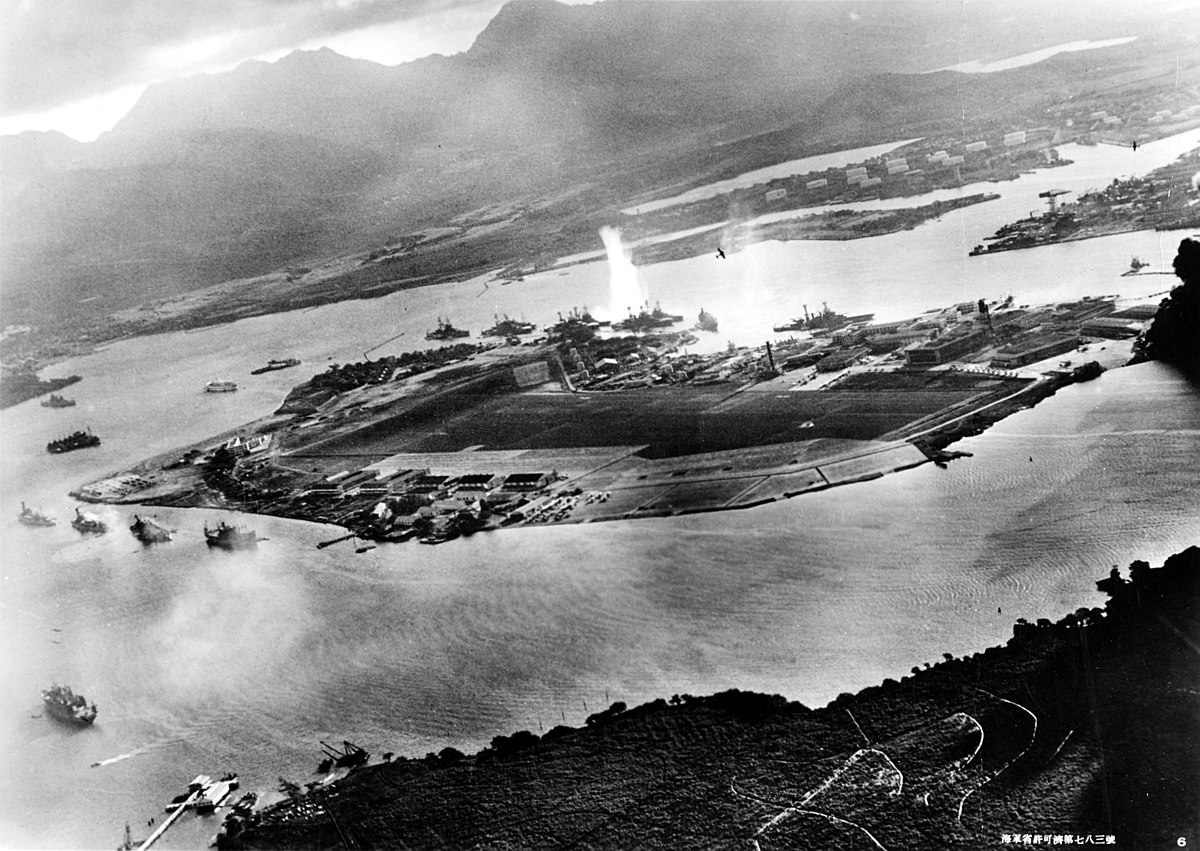
On December 7th 1941, on
an otherwise peaceful Sunday morning on a beautiful Hawaiian island, the first
wave of Japanese airplanes left 6 aircraft carriers and struck Pearl Harbor a
few minutes before 8 AM local time.
In two waves of terror
lasting two long hours, they killed or wounded over 3,500 Americans and sank or
badly damaged 18 ships - including all 8 battleships of the Pacific Fleet - and
over 350 destroyed or damaged aircraft.
At least 1,177 lives were lost when the Battleship U.S.S. Arizona exploded
and subsequently sank.
However, they did not
sink any of our Pacific aircraft carriers and they left most of the fuel that
was needed to win the war in the Pacific.
In one stroke, the
Japanese navy scored a brilliant success—and assured their ultimate defeat.

Is a part missing from this, where it says to read the eyewitness account?
ReplyDeleteSorry! Fixed it.
ReplyDelete