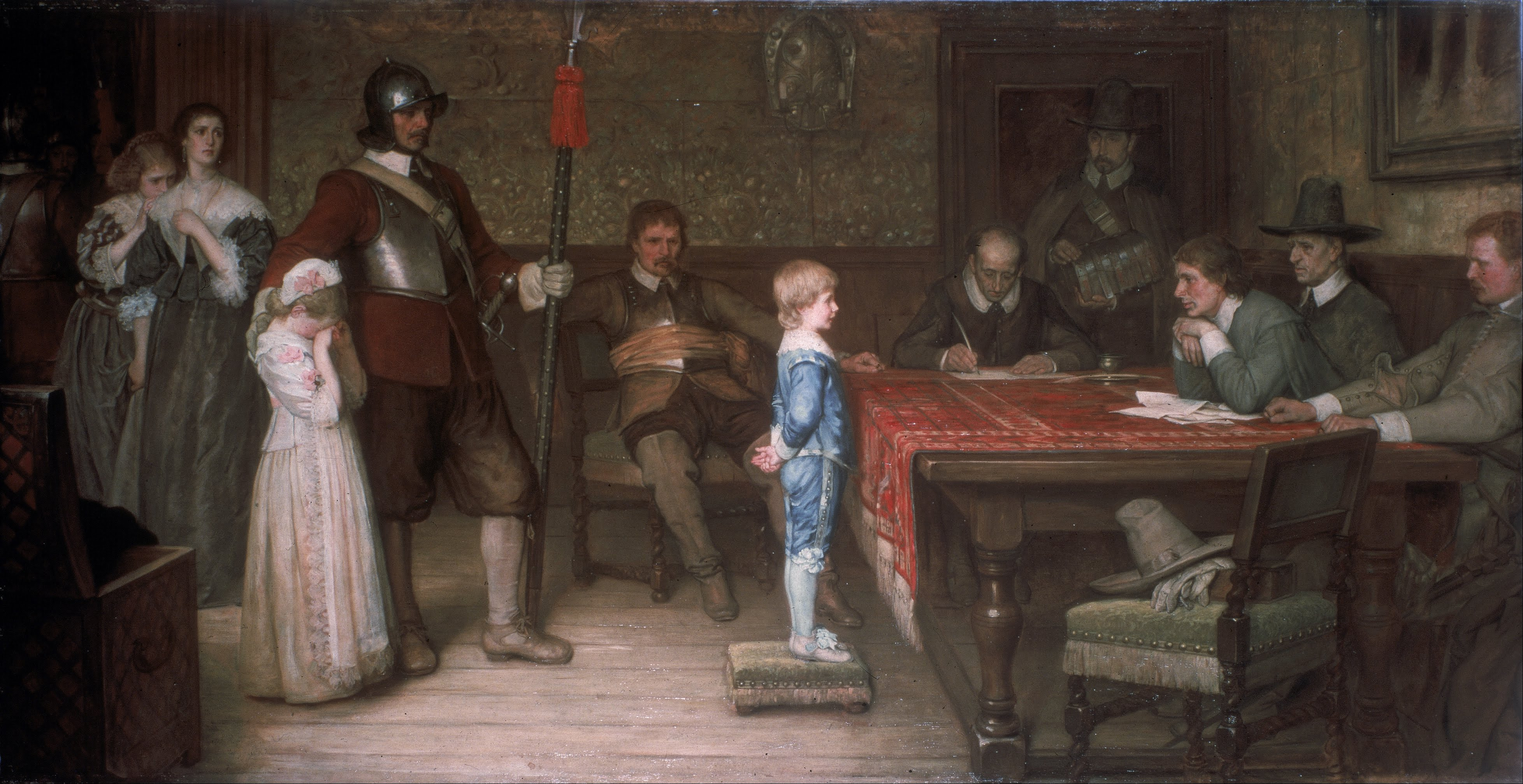
THE PURITANS AND THE CAVALIERS
Who were the Puritans and the Cavaliers? The answer to that question, which has bearing on today's America, goes back to the year 1066. Many of you may have noticed that the English language can be a bit confusing. It is often noted that in English, we tend to have multiple words for the same thing. For instance amongst foods there is beef and cow, mutton and sheep, chickens and poultry. As you likely already know, this division in our language between animals and meats is also a division in languages, with the animal names coming from Saxon and the food names coming from Norman French. This division reflects the fact that after the defeat of the Saxons by the Normans at the Battle of Hastings, England was ruled by Norman knights who did the eating, but not the raising, of animals.
This conquest, however, had a much bigger impact on English, and by extension American, culture, than simply giving us odd food names. Having an upper class that dressed differently, ate differently, and even spoke differently, gave England a unique gift. Entirely by accident, England had stumbled upon what we now call: the division of powers. By being a foreign entity, the Norman upper class found itself forced to cooperate with locals of the middle classes in order to efficiently rule their dominion. In America, we continued this tradition of dividing powers by creating a federal government with three branches, but it accomplishes essentially the same thing!
Even after the Norman conquerors had fully integrated into English society, remnants of the division remained. After Henry VIII led England out of the Roman Catholic church in 1534 (in order to secure a divorce) he simple left Catholic theology and worship in place. This, however, left English religious life in confusion. Many protestants who followed the innovations of Huldrych Zwingli (1484-1531) and John Calvin (1509-1564) felt that Henry VIII had missed an opportunity to 'protestant-ize' the Anglican Church. Meanwhile, Catholics felt that King Henry had broken the unity of the church and endangered the souls of his countrymen by leaving the Catholic Church. This division in English religious life led to violent conflict and waves of executions. As part of her effort to calm England, Queen Elizabeth I decided to pursue a middle way. By embracing the theology of continental reformers while retaining the pageantry and beauty of the Catholic worship service, she sought to please everyone. Everyone, needless to say, was not pleased!
Many radical protestants, who saw the Catholic worship-style of the Anglican Church as decadent and foreign, began to call on Elizabeth to 'purify' the church. During the time of Queen Elizabeth and King James, these 'precise men', as they were often called, not only pushed for a thoroughly Calvinist Anglicanism, they also began to seek political change as well. At the heart of Puritanism's political ideology were two distinct impulses. One was a recognition that the protestant belief in the 'priesthood of all believers' had distinct political implications, namely the equality of all believers. This belief stood in contrast to the ancient ideas of a God-given hierarchy upon which both Catholicism and Feudalism had built their foundations. The other impulse, inherited from hundreds of years of Norman-Saxon enmity, was a lasting division between the upper and middle classes.
Many of England's Puritans hailed from the yeoman class of property owning, but not genteel, businessmen. These hardworking individuals naturally took to the ideals of efficiency, simplicity, and equality that were the unifying heart of Puritanism. England's upper classes, in contrast, held firm to the traditional pageantry of high church Anglicanism, just as they remained true to the belief in a God-given hierarchy, with the King firmly at the top, both serving and ruling his people.
Many Americans tend to view the Puritans as a small faction in England, bullied by the much more powerful high church Anglicans. This, however, was not the case. Between 1642 and 1651 England was divided by a Civil War between the Puritan Roundheads and the largely high church Royalists. In the end the Roundheads, led by a Puritan yeoman farmer named Oliver Cromwell seized power and executed King Charles I in 1649. Between 1649 and 1653, England was ruled by parliamentary forces as a Commonwealth. Subsequently, from 1653-1658, Cromwell personally ruled as a dictator over the Protectorate of England, Ireland, and Scotland. The Cavaliers would have their revenge, however. In 1659, after Cromwell's son was unable to subdue radicalism in the Army, England fell into chaos and conflict, and seeking a return to calm, Parliament begged Charles I's son Charles II, to return. With his restoration, peace was also restored, but many Puritans left the Church of England to form Congregationalist and Presbyterian churches.
In America, the division between Puritan and Cavaliers remained evident in the regions largely settled by their descendants. New England with its Puritan ancestry became a region known for its industry, austerity, and belief in equality. In contrast, the areas settled by the Cavaliers along the southeastern seaboard tended to retain the more colorful characteristics of their forbears, along with a vision of God-given hierarchy. These conflicting worldviews played a major role in dividing America in half, especially as we came to deal with two very different visions of human equality, during our own Civil War.
________________________________________________________________________
Important Terms:
Puritan: a member of a group of English Protestants of the late 16th and 17th centuries who regarded the Reformation of the Church of England under Elizabeth as incomplete and sought to simplify and regulate forms of worship.
Cavalier: A supporter of King Charles I, typically of the knightly classes, often known for their flamboyant clothing, characteristic of the upper classes of the 17th century.
English Civil War: A period of conflict from 1642 to 1651 between parliamentarian Roundheads and royalist Cavaliers. The war ended with the execution of King Charles I and the elevation of Oliver Cromwell to leadership.
______________________________
Watch this documentary on the English Civil War: Monarchy: Oliver Cromwell

No comments:
Post a Comment